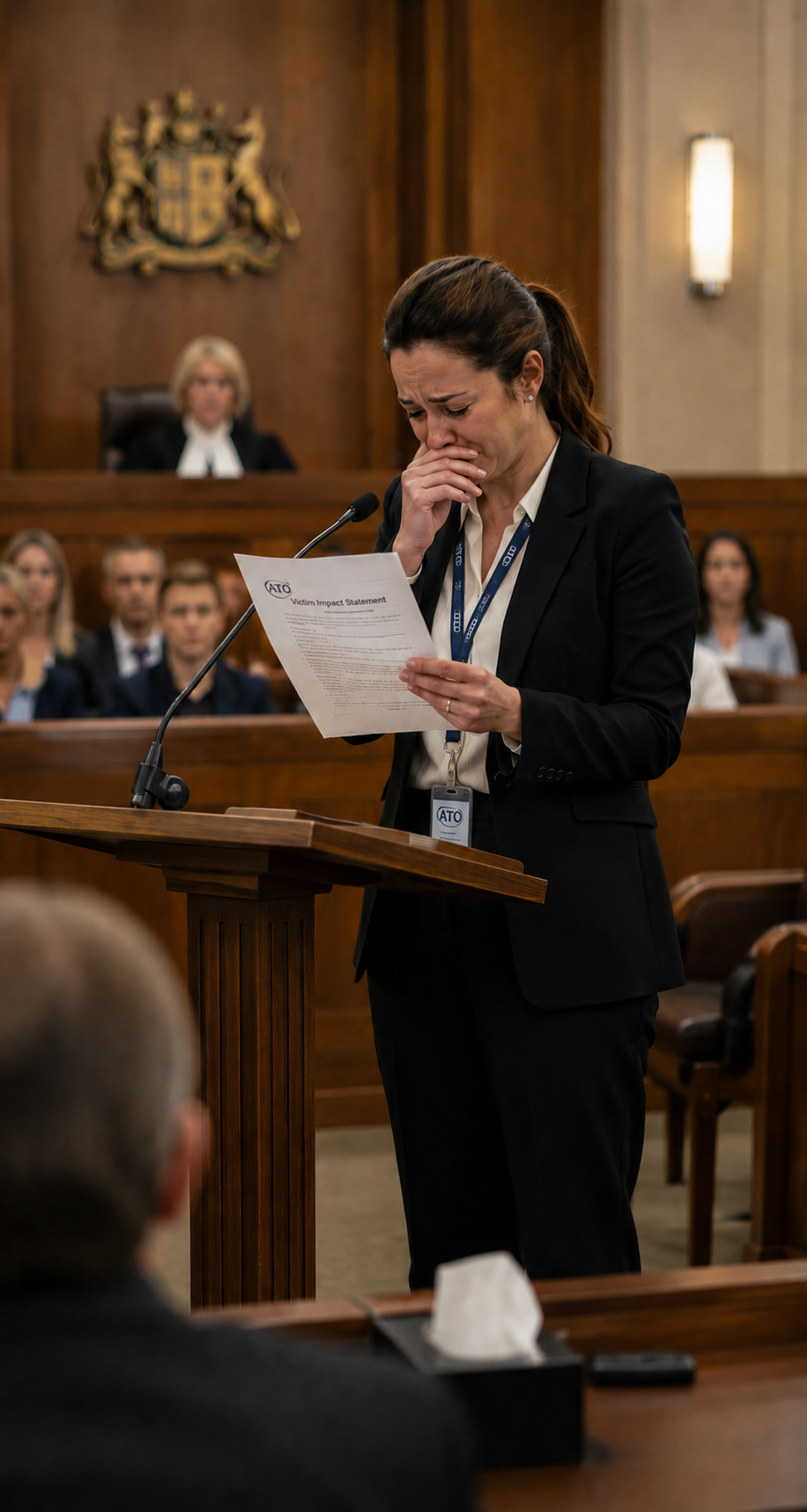

Victim Impact Statement Details Trauma of Court Ruling Against ATO
15 July 2026
ISSUE NO. 34
CANBERRA — The Australian Taxation Office has published a Victim Impact Statement describing the profound and lasting trauma inflicted on the agency when three judges of the Full Federal Court unanimously upheld what a single Federal Court judge, and before him a member of the Administrative Review Tribunal, had already identified as the clear words of the statute.
The statement, understood to run to 47 pages, is written in the first person and details the emotional toll of losing the same argument three times, before five different decision-makers, in a matter the ATO had been advised at every stage it would lose.
“On the morning of the judgment, everything felt normal,” the statement begins. “We had a view. We had held it for years. We had applied it to thousands of taxpayers. Then, at 10:15am, a judge read out what the legislation actually says, and our world changed forever.”
“People ask us why we kept going after the Tribunal said no, and a judge said no, and three more judges said no,” the statement continues. “But you never think it will happen to you. Then it happens to you three times.”
The statement describes a lasting loss of safety within the agency. Officers now flinch at the word “appeal.” Some can no longer walk past the Federal Court without crossing the street. “We no longer feel safe issuing assessments,” one passage reads. “Every time we take a position with no basis in the statute, we wonder — is this the one they’ll uphold the law on?”
A full chapter is devoted to the audit team, whose position paper was described by the primary judge as “unencumbered by the statute,” having quoted the relevant provision once, in a footnote, incorrectly. “They were only doing what they had always done,” the statement reads. “And now they are being publicly criticised, simply for auditing on a view the legislation does not support. Where is the support for them?”
The trauma, the statement explains, was compounded at the objection stage, when the taxpayer’s 80-page objection was determined by way of the original audit position paper with the heading changed, the auditor’s name still in the footer, and a tracked-changes comment reading “just reuse this.” The statement defends the objection officer, noting he “had already been through so much,” and that rewriting the position paper “would have meant reading it.”
The statement reserves its strongest language for the taxpayer, who it says has shown no remorse. “He spent seven years and $400,000 proving what a Tribunal member, a Federal Court judge, and three Full Court judges all regarded as obvious, and he continues to arrange his affairs in accordance with the law as declared by the Full Court — as though nothing happened.”
In a section headed “Path to Healing,” the ATO confirms the decision is confined to its facts, and that its existing view will continue to apply to all taxpayers whose facts differ in any respect, including spelling of the taxpayer’s name. “Those were those judges, on that day,” the statement reads. “With different judges, we truly believe it could have gone another way. Holding onto that belief is an important part of our recovery.”
Pending that recovery, officers have been instructed to continue applying the Commissioner’s preferred view in private rulings until the agency “finishes reflecting,” a process with no scheduled end date.
A final section, titled “Protecting Others From What Happened To Us,” warns taxpayers against premature certainty, noting that arrangements of the kind considered by the Court may yet attract section 100A, Division 7A, family trust distributions tax, Part IVA, or “other provisions we have not yet identified but remain hopeful about.”
An ATO spokesperson said the agency was focused on recovery.
A separate spokesperson said the agency respectfully disagreed with the law.
A third spokesperson confirmed a High Court appeal was being considered, primarily to assist with closure.
The Commissioner denied that the agency has difficulty accepting adverse decisions, noting that the ATO follows every court decision it agrees with.
At press time, the ATO’s existing view remained published on its website, marked “unaffected.”
This article is satire, and is confined to its facts.