
Treasurer Announces Rushed Tax Amendments To Patch Rushed Tax Amendments
26 August 2026
ISSUE NO. 40
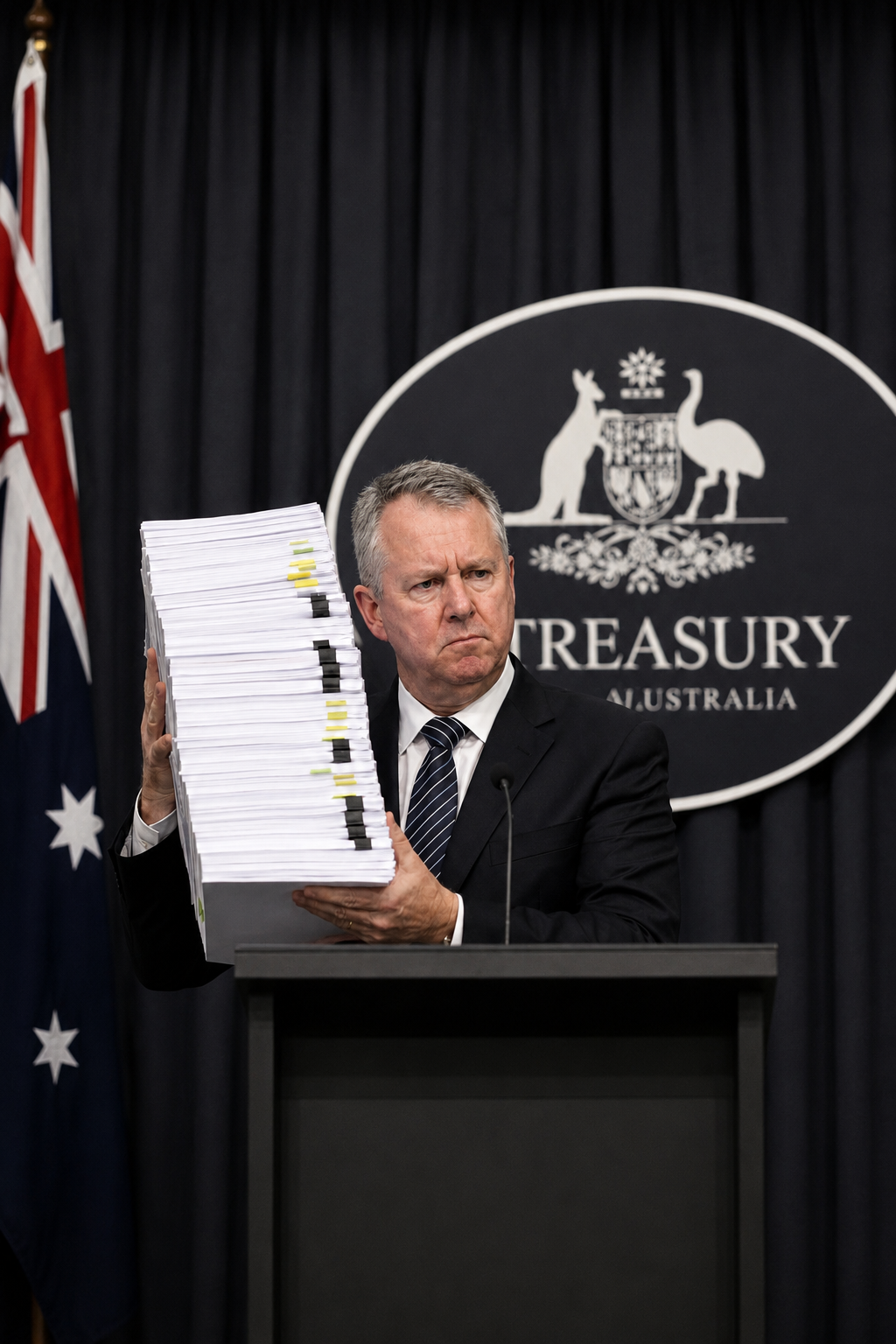
CANBERRA – The Treasurer has announced further amendments to the Government’s tax reforms to fix problems in the legislation introduced to implement the reforms, rejecting suggestions that the legislation had been introduced before the reforms had been worked out.
The Treasurer said the amendments had been carefully considered.
Further amendments will follow.
The reforms announced in the Budget replaced the capital gains tax discount with indexation and a 30 per cent minimum tax.
Start-up investors noted that removing the discount would discourage investment in companies whose value was mostly future growth.
The Treasurer said the Government had always intended to encourage innovation.
An Innovative Business CGT Concession was announced.
Treasury opened a three-week consultation to determine what an innovative business was.
The final definition would be legislated in a later tranche.
The Treasurer said this would provide certainty.
Nova.AI, an artificial intelligence company, confirmed that it was innovative.
The assessment was performed by Nova.AI.
The first tranche of the reforms was then passed.
During debate, it was noted that an investment property grandfathered from the new rules could lose that protection when one owner died and their spouse inherited their share, or when ownership changed following a relationship breakdown.
The Treasurer said the Government had always intended to protect widows and separating spouses.
Draft legislation containing the fix was released for consultation, with submissions closing on 21 August.
The amendments were passed by Parliament on 19 August.
The Treasurer rejected the suggestion that passing the amendments before consultation on them had closed was rushed.
He said the Government was simply implementing more quickly what it had always intended to implement later.
The Institute of Taxation, Actuarial and Accounting then noted that the CGT amendments required gains before and after 1 July 2027 to be separated, requiring market values to be determined for assets that had never previously needed to be valued on that date.
Treasury released further rules to simplify the valuation process.
The simplified valuation rules ran to 74 pages.
Local bloke Steve announced that he would become an asset valuer to meet the expected demand.
Steve had no valuation qualifications, but said this had not presented a problem.
He registered a business name and now describes himself as a registered valuer.
The Treasurer said the Government had always intended the reforms to create jobs.
The Treasurer then turned to the new 30 per cent minimum tax on discretionary trusts.
The tax had been announced in May.
Treasury opened consultation in July on how the core arrangements would work.
The Treasurer said the purpose of the measure was to prevent income splitting.
Asked what income was being split, given that the trustee derived the income and beneficiaries were taxed on their shares under the existing trust tax regime, Treasury said trusts were commonly used for income splitting.
Asked for its authorities, Treasury cited the Wikipedia article on income splitting and a copy of The Barefoot Investor in the staff kitchen.
The Treasurer said the Government had always intended to prevent income splitting, including where no income was actually split.
By August, the purpose of the reforms was to simplify capital gains tax, preserve existing gains, encourage innovation, protect widows and separating spouses, create jobs for valuers, prevent income splitting whether or not income was split, and provide certainty on matters still being consulted upon.
The Institute noted that some of those purposes appeared inconsistent.
The Treasurer rejected the suggestion.
A further amendment would clarify them.
The Australian Taxation Office then advised that disagreements about the value of an asset on 1 July 2027 should be determined by reference to the taxpayer’s star sign.
The Treasurer said this would improve consistency.
He said the Government had always intended the reforms to operate consistently.
An ATO spokesperson said the star-sign method would improve consistency.
A separate spokesperson said capital gains tax had always been administered by reference to the taxpayer’s star sign.
A third spokesperson said capital gains tax had never been administered by reference to the taxpayer’s star sign and that further legislative amendments were being considered.
As the Treasurer spoke, a Treasury officer at the side of the stage was observed drafting the amendments on a napkin.
The Treasurer rejected the suggestion that they were rushed.
When the napkin was full, the officer turned it over and continued.
The Treasurer said the amendments had been carefully considered and would provide certainty.
He then announced a further amendment.
The Daily Cartland is a work of satire. This disclaimer reflects the original intention and may be clarified by further amendment.