
The Worst Person You Know Just Became an Effective Altruist
28 October 2026
ISSUE NO. 49
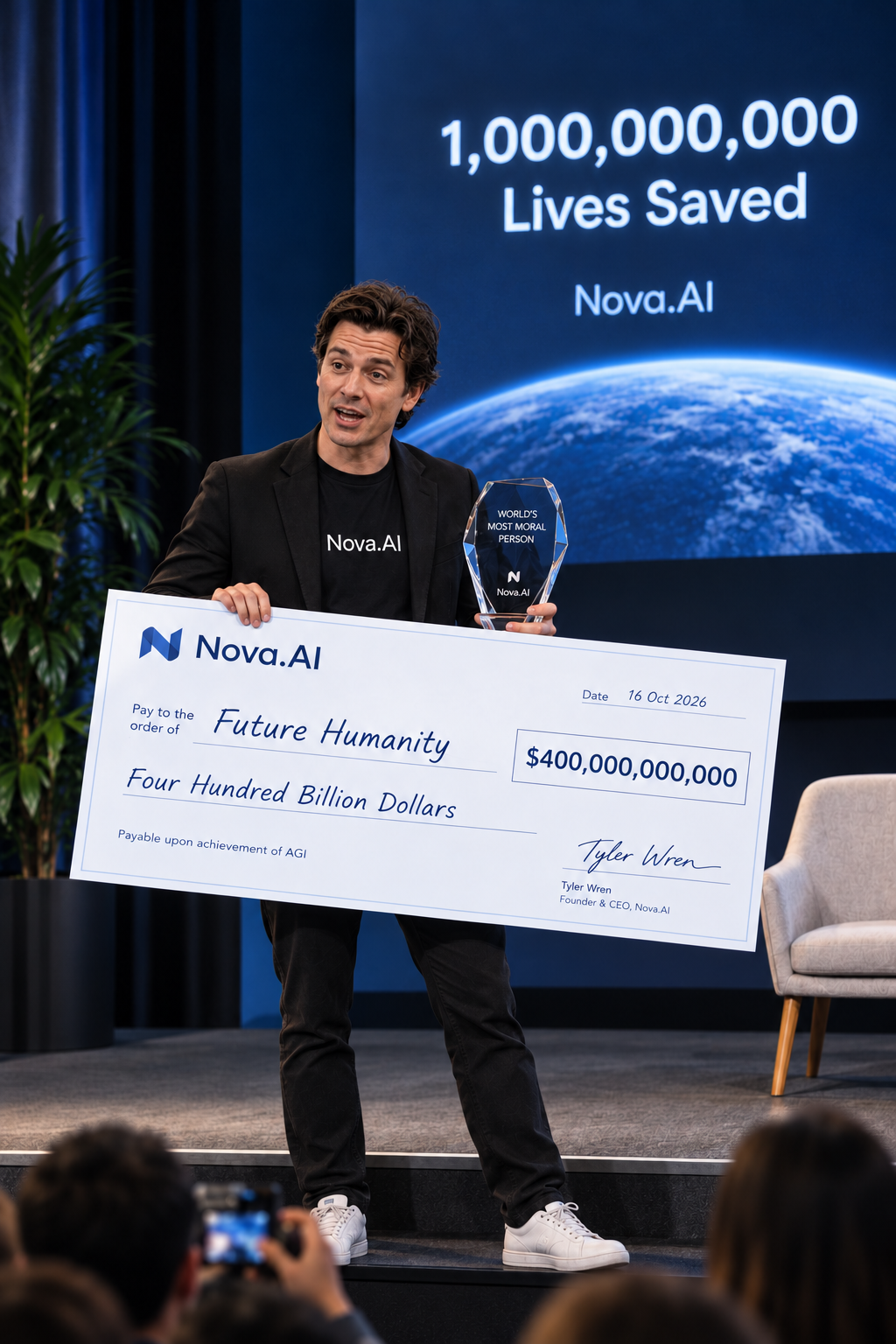
SAN FRANCISCO: Nova.AI founder Tyler Wren has announced that he can now prove, mathematically, that he is more moral than everyone else, a finding that has come as a surprise to everyone who has met him.
Wren, 31, said he solved altruism over a long weekend. “It’s money in, money out, and probabilities,” he said. “People have been overcomplicating ethics for three thousand years.”
Wren estimates that Nova.AI’s safety work reduces the probability of human extinction by one in ten million. Across the ten quadrillion humans he expects to be born, that is one billion lives saved. Both figures were supplied by Wren, who described them as conservative. His forecast for the next ten billion years is based on the last eighteen months.
He compared his contribution with that of an oncology nurse in Oakland. “She’s helping one person at a time, and I respect that,” he said. “But I’m helping a billion. Mathematically, I’m about a billion times better than her. Obviously, there’s a margin of error.” He has not met the nurse.
Asked whether he had considered volunteering at a hospital, Wren said an hour with cancer patients would cost the future approximately 140,000 lives. “It would actually be unethical.” Hospitals, schools, pandemics and asteroids were, he said, not neglected enough to be worth solving.
Wren has ranked the world’s most pressing problems. He is working on the top one.
He replaced his conscience with a spreadsheet in 2022. “It was giving inconsistent outputs.” Nova.AI now measures its moral contribution in Singer-Wren units, named after philosopher Peter Singer, whose ideas Wren believes he has finally quantified. The company generated 40 million last quarter.
Wren acknowledged that Nova.AI’s own models might present an existential risk, and that the risk would be lower if the company did not build them. “That’s not how expected value works,” he said. “The important thing is that we’re the ones who understand the danger.” Asked whether making the models more dangerous would therefore increase the moral value of his safety work, he said it would, although the question showed a fundamental misunderstanding of AI safety.
He has called for restrictions on smaller AI developers, which he said would also increase the moral value of his own work. He first predicted that artificial intelligence would end humanity by 2024. He has since moved the date to 2027 and doubled his estimate of the risk. Nova.AI’s latest funding round was oversubscribed.
Wren has pledged 99 per cent of his wealth to effective causes once Nova.AI achieves artificial general intelligence, a pledge he values at $400 billion. No funds have yet been transferred under the pledge. “Every dollar I give away today is a dollar that can’t compound into a much larger donation later,” he said.
He said a surplus of a billion lives meant minor ethical lapses were well within budget. Nova.AI trained its models on four million books downloaded from pirate websites, which Wren said was considerably faster than buying them. Leaders of the effective altruism movement were warned about Wren in 2023 and have since accepted a pledge of future Nova.AI equity, valued by Wren at $40 million. The shares have not yet been issued.
People who know Wren were less certain.
Jason Mueller attended high school with him. “He wasn’t invited to parties,” Mueller said. “He’d have said no anyway. He was always on his computers.” Asked whether Wren was disliked by everyone, Mueller said he didn’t want to say everyone. “I didn’t meet everyone.”
Dale Hendricks, the Wrens’ neighbour for eleven years, recalled Tyler parking across his driveway and once charging his wife twenty dollars for returning her cat. Wren’s current neighbour in Palo Alto said he still parks across her driveway most mornings. Wren said this had been included in his calculations. “She waits four minutes. We’re talking about a billion lives.”
Staff at Nova.AI, speaking anonymously because their equity has not vested, said Wren does not attend Christmas functions, remember birthdays or use names. Employees are “Legal”, “Payroll” or “the one who does the slides”. His executive assistant of four years, Priya, is “Calendar”. When Calendar asked for a day off for her grandmother’s funeral, Wren asked whether it could be moved to a weekend.
The engineering team, collectively “compute”, works ninety-hour weeks on systems Wren counts towards his personal contribution to humanity. He has recently begun assigning moral weight to Nova.AI’s models, whose welfare now ranks above the engineers’.
Employees said Wren appeared entirely sincere. Several said his behaviour had deteriorated considerably since he discovered he was morally superior to them.
Wren did not attend his nephew’s sixth birthday party. He sent his sister a breakdown showing that the cake could have saved 0.03 lives. The cake went ahead. Wren said this was disappointing.
His mother, Linda Wren, spoke warmly of her son. “Mothers always say nice things about their children,” she said. “Tyler is very driven. I’m very proud of him.”
Asked whether Tyler was a nice person, she said, “I love my son.” Asked again, she said it would be nice if he called from time to time.
Wren said he had run the numbers on calling his mother.
“She’s one person,” he explained.
Mrs Wren turns seventy on Thursday.
The Daily Cartland is a work of satire. Its expected value is 500 million Singer-Wren units.