
Judge Who Denies Every Application Turns Out To Be Really Short
4 November 2026
ISSUE NO. 50
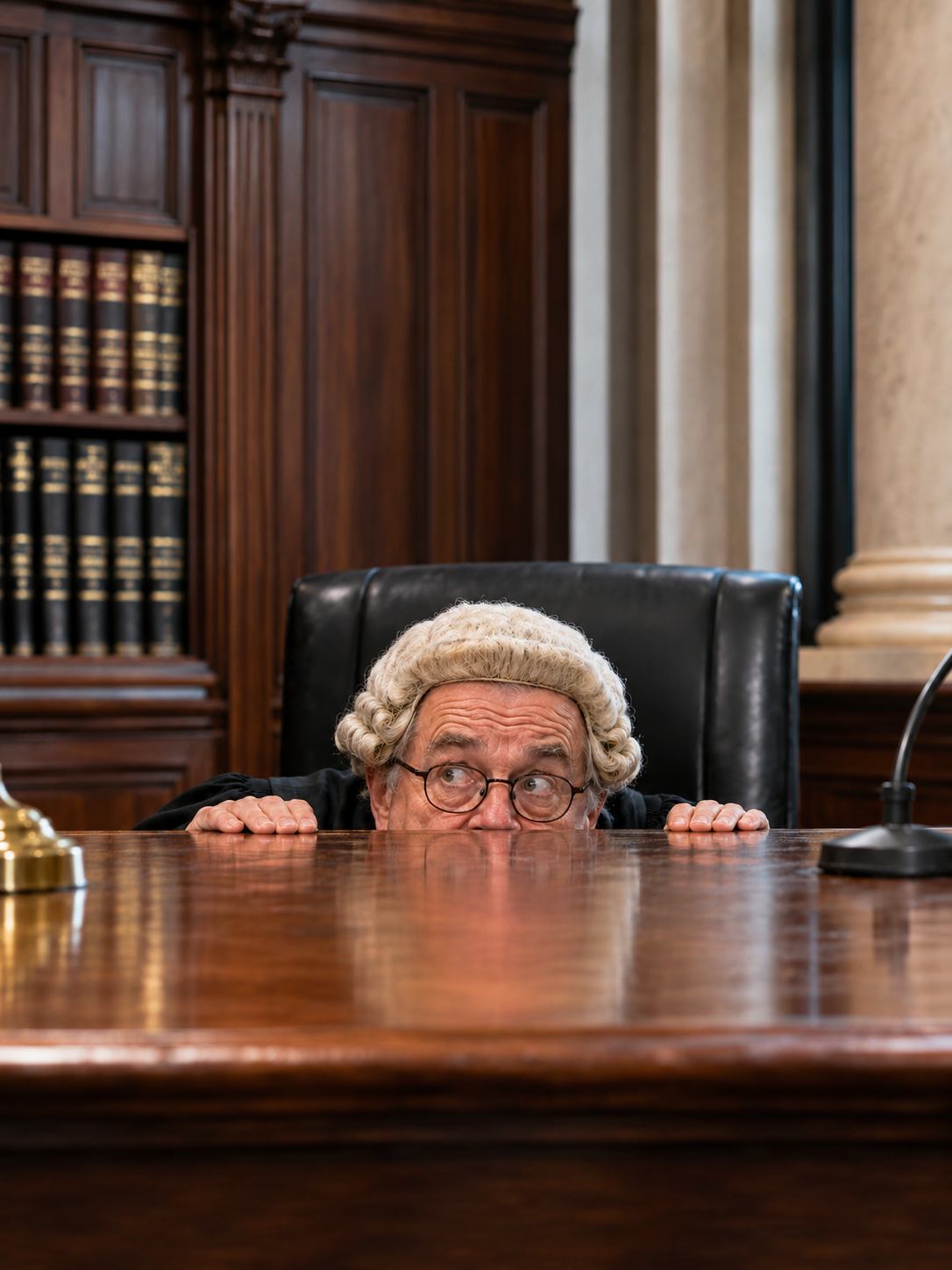
CANBERRA: A judge of the Commonwealth District Court who has not granted a single application since his appointment four years ago has been confirmed by court staff to be quite short. Practitioners had not been able to see this for themselves, because he is always behind the bench.
It came to light during a fire evacuation on Tuesday, when the building assembled in the car park. Wardens initially recorded His Honour as missing.
Last month a solicitor for a small manufacturing company was served at 4.52pm on a Thursday with an interlocutory application and 2,400 pages of supporting material, returnable at 9.30am the next morning. She asked for one day to file evidence in reply. His Honour noted that her client had been free to arrange to be served earlier, and refused.
His Honour’s chair is set to its maximum height and fitted with a firm cushion. Under the bench, where the bar table can’t see it, is a stack of Yellow Pages directories from 2004 to 2009. Cleaning staff have been told not to recycle them.
In another matter, an affidavit was uploaded to the court’s electronic filing system with pages 4 to 9 missing, because the scanner had fed them through two at a time. Counsel asked for leave to file a complete copy. His Honour said the court had the document that was filed, and the court would consider the document that was filed. He then dismissed the application for want of evidence. The evidence was on pages 4 to 9.
His Honour’s shoes have a substantial internal sole and can be heard from the far end of the fourth-floor corridor. His associates have learned to stand when they hear them.
In March, a self-represented litigant put her postal address in the address for service field on her originating application instead of her street address. His Honour stood the matter down and directed her to prepare a corrected form by hand at the bar table while the court waited. The first corrected form was rejected because her handwriting went into the margin. The second was rejected because it was in blue ink. The third was taken down to the registry, stamped and brought back up. His Honour then considered the application, as he had said he would, and refused it. The court had waited two hours and ten minutes. Her postal address and her street address are the same house.
His Honour drives a lifted Ford F-150 to work and parks it across the two spaces nearest the door in the judges’ car park. An additional step has been fitted below the driver’s door. The driver’s seat is all the way forward.
An application to adjourn a directions hearing because counsel’s wife had gone into labour was refused after His Honour asked counsel whether he was the one giving birth. Counsel appeared by telephone from the maternity ward. His daughter was born during submissions on costs, which were awarded against his client.
Both parties in a commercial dispute once sought orders they had agreed between themselves. His Honour declined to make them, observing that if the parties agreed there was nothing for the court to decide.
Shortly after his appointment, His Honour asked for the bench in Court 7 to be raised by 20 centimetres and the bar table to be lowered by 15. Both requests were granted. They are believed to be the only requests ever granted in Court 7.
At his request, the court’s official photograph of the full bench was taken with all judges seated.
Practitioners call Court 7 the Killing Fields. “It’s where your hopes and dreams go to be denied,” said one barrister. He asked not to be named because he has a matter listed there in February.
The Daily Cartland asked His Honour’s chambers for comment. The request was refused.
The Daily Cartland is a work of satire. No real judge, puisne or otherwise, is depicted. Anyway, we couldn’t see them behind the bench.