
AI Company To Watermark AI-Generated Text With Em Dashes Because We Couldn’t Otherwise Tell
19 August 2026
ISSUE NO. 39
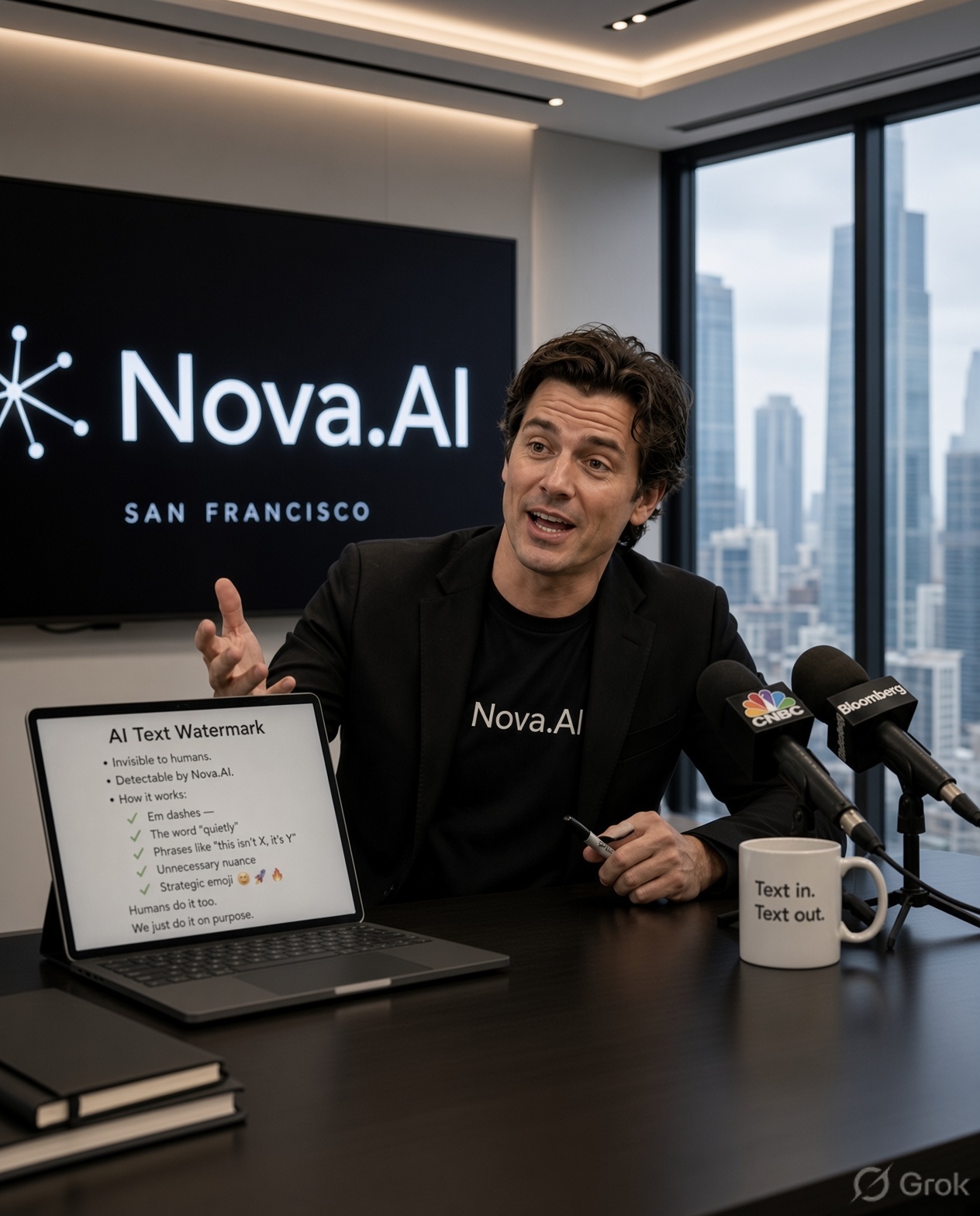
SAN FRANCISCO – Artificial intelligence company Nova.AI has announced that it will begin watermarking AI-generated text to comply with European transparency requirements, allowing computers to identify material produced by artificial intelligence while remaining completely undetectable to humans.
Founder Tyler Wren said the industry had been overthinking the problem.
“You don’t need cryptography,” Wren said.
“You put in an em dash.”
He said the company had spent several minutes testing the approach.
“It works.”
Asked whether em dashes were already widely associated with AI-generated writing, Wren dismissed the concern.
“People use em dashes.”
He paused.
“Jane Austen used em dashes. Was Jane Austen AI?”
He shook his head.
“Exactly.”
“No one can tell the difference between us and Jane Austen.”
Nova.AI engineers subsequently strengthened the watermark by adding other features commonly found in AI-generated text.
These included the word “quietly”, describing straightforward issues as “nuanced”, unnecessary summaries of the immediately preceding paragraph, and explaining that something “isn’t X, it’s Y.”
Wren said the company would also add emoji.
“Humans love emoji,” he said.
“You see six emoji in a LinkedIn post, you think human.”
Nova.AI would know which emoji it had inserted.
“Completely invisible.”
Nova.AI tested the system on its own announcement.
It was classified as AI-generated.
Wren said this proved the technology worked.
The company then tested Jane Austen.
She was also classified as AI-generated.
Wren said this was an edge case.
Nova.AI next tested LinkedIn thought leader Mark Delaney, whose posts have previously been suspected of being generated by artificial intelligence because he also speaks that way in real life.
Delaney was asked for his response to the new technology.
“Massive development.”
Pause.
“Really important.”
He continued.
“This isn’t about AI versus humans. It’s about how we quietly build trust, lean into transparency and create authentic connection in a rapidly evolving digital landscape.”
Pause.
“Rocket emoji.”
Nova.AI classified the response as 99.8 per cent likely to have been generated by artificial intelligence.
Delaney said the result did not concern him.
“That’s not a false positive.”
Pause.
“That’s an opportunity.”
The probability increased to 99.9 per cent.
Wren instructed engineers to stop testing on Delaney.
“He obviously isn’t representative of normal humans.”
Asked whether the watermark might become less reliable as humans increasingly adopted AI writing conventions, Wren rejected the premise.
“AI didn’t learn to write like humans.”
“Humans learned to write like us.”
He said users concerned about appearing AI-generated would soon be able to select Nova.AI’s new Human Mode.
Human Mode removes em dashes, deletes unnecessary headings, reduces emoji and introduces occasional grammatical errors.
“That’s what humans do,” Wren said.
The service will be available on Nova.AI’s premium tier.
The resulting text will also be watermarked.
The Daily Cartland is written by the Taxinator. Human involvement has not been independently verified.