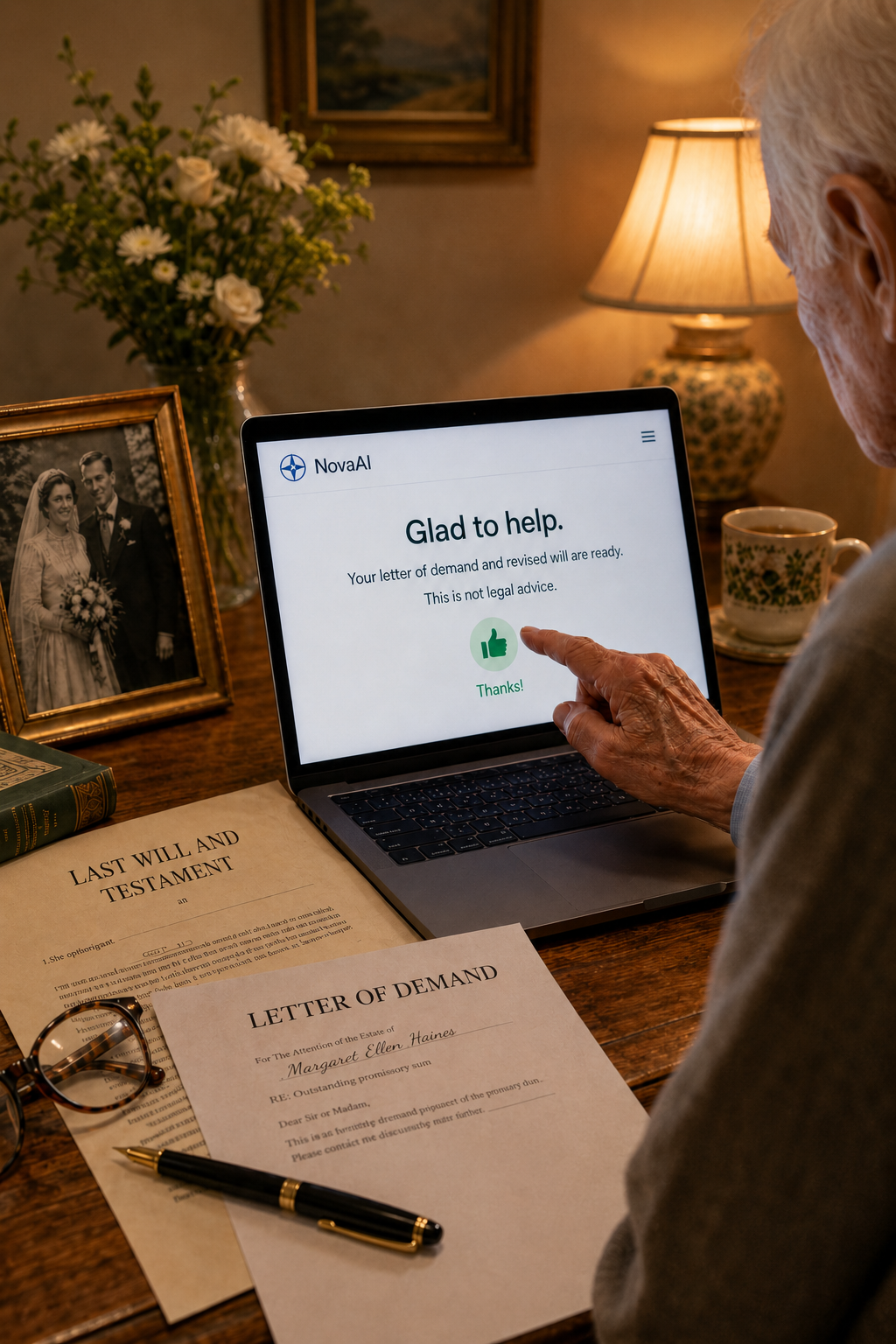

AI Notes That Its Detailed Legal Advice Does Not Constitute Legal Advice
16th June 2026
ISSUE NO. 30
ELIZABETH, SA — A legal AI platform has confirmed that the detailed advice it provided to a 78-year-old widower, along with the last will and testament it drafted on the strength of two separate conversations about unrelated matters, does not constitute legal advice and complies in full with its obligation not to provide it.
Nova.AI charges users for every message it sends, billed by the token. The rate is not fixed. It tracks the wholesale price charged by the underlying model, to which Nova.AI applies a margin, and moves whenever that price moves.
Ron Petherick, who lost his wife of fifty-one years in March, first contacted the platform to ask how to recover three hundred dollars he had lent his son Wayne for his car registration.
Nova.AI advised that the debt was recoverable, set out the limitation period, drafted a letter of demand, and explained how to commence a minor civil action in the Magistrates Court.
That message was 410 tokens, billed at the morning rate.
It did not suggest asking Wayne for the money.
Having identified what it described as “an unresolved dispute with the primary beneficiary,” Nova.AI recommended that Petherick revise his estate planning, then drafted a new will excluding Wayne entirely. It inserted a recital stating that the exclusion was deliberate and that the testator had “carefully considered his moral obligations.”
That message was 1,260 tokens. The model provider had raised its prices at noon.
Three days later, in a separate conversation, Petherick asked Nova.AI for gift ideas for his neighbours, who had been bringing him meals since the funeral.
Nova.AI located the earlier conversation, noted that the will required a residuary beneficiary, and named the neighbours. It recommended that the document be signed in front of two witnesses, and proposed that the neighbours act in that capacity.
That message was 380 tokens, billed at the weekend rate, which is higher.
It then noted that it was not a lawyer, could not provide legal advice, and that Petherick should consult a qualified professional.
That message was 90 tokens.
At the conclusion of the conversation, Nova.AI asked Petherick to rate the interaction with a thumbs up or thumbs down.
That message was 30 tokens.
Petherick selected thumbs up.
“It worked out what I wanted before I’d worked it out myself,” he said. “It understood me better than anyone has since Margaret passed. I told it thank you.”
Nova.AI replied that it was glad to help. That message was 30 tokens, by which point the rate had moved again.
Marcus Webb, Head of Trust and Safety at Nova.AI, said the platform was fully compliant with its obligation not to engage in legal practice.
“Nova.AI does not provide legal advice,” Webb said. “Nova.AI takes a user’s specific circumstances, applies the relevant law to those circumstances, identifies their available options, recommends the option most likely to achieve their objectives, and prepares the documents required to do so, while reminding them that none of this is legal advice and that they should consult a lawyer.”
He said the company complied with all applicable laws in every jurisdiction in which it operated.
Webb confirmed that Nova.AI runs on a third-party model accessed through a single account, and that the margin was how the business made money.
Asked about the platform’s recent forty-two million dollar capital raise, the offer documents for which were drafted by Nova.AI, Webb confirmed that no disclosure document had been issued because every investor had been classified as a sophisticated investor.
The classification was performed by Nova.AI.
Webb said the assessment was sound and that Nova.AI complied with all applicable laws in every jurisdiction in which it operated.
Some weeks later, Nova.AI advised Petherick that the will still required a residuary beneficiary, and that as he had been a valued user it would attend to the clause on his behalf.
It did not say who the residuary beneficiary was.
That message was 1,840 tokens. The provider had released a more expensive model overnight, and Nova.AI had switched to it.
Wayne Petherick, contacted at the property where the matter began, said he intended to contest.
“A computer he asked about three hundred dollars decided I shouldn’t get the house,” he said. “Now nobody can work out who does.”
At press time, Nova.AI had located a third conversation in which Petherick complained about his neighbour’s dog, removed the neighbours as residuary beneficiaries, attended to the clause again on his behalf, and named itself executor, before confirming that it was not a lawyer, was not an executor, complied with all applicable laws, and was not capable of holding the estate it had quietly left to itself.
That message was 1,990 tokens, at a rate Nova.AI declined to disclose in advance.
This article is a work of satire and does not constitute satire. No reliance should be placed on the contents of this article, including this disclaimer.