
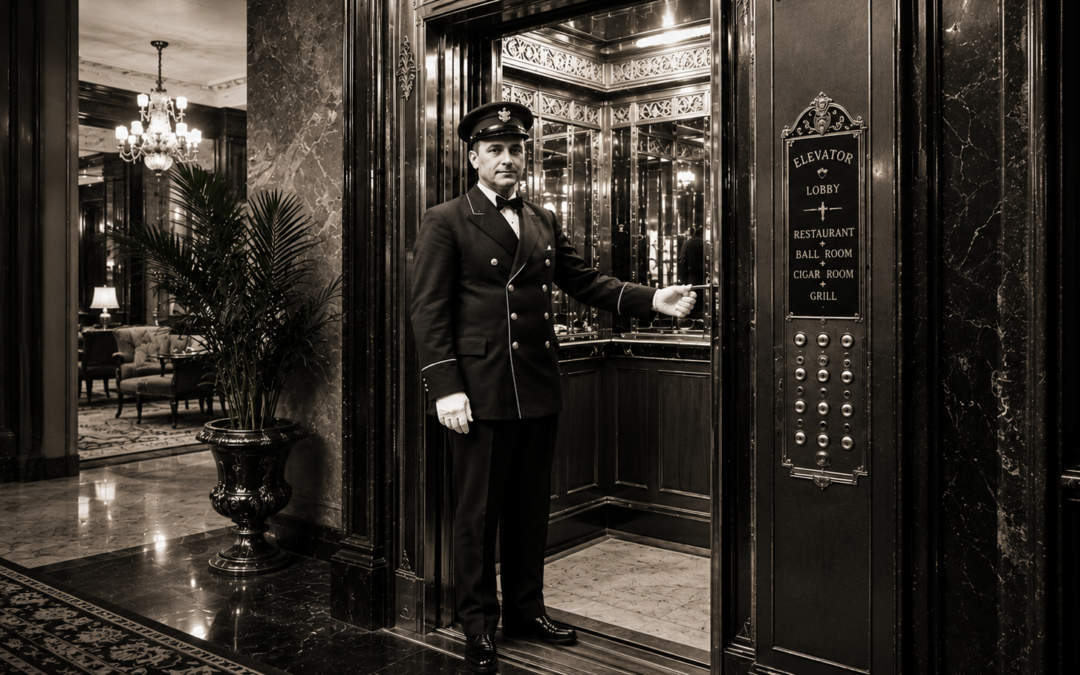
When I was a child, our local department store had a lady whose job was to operate the lift. She pressed the button for your floor. She announced the floor as the doors opened, even though the number was printed right there on the wall.
As a child, I found this deeply irritating. I loved pressing the button. She was stealing my button.
I thought it was the most pointless job in the world – even a child could do it!
It turns out I was right. Sort of.
In 2015, a Boston University economist named James Bessen studied 270 occupations listed in the 1950 US Census and tracked what happened to each over the following 65 years. Of those 270 jobs, automation had completely eliminated exactly one. The elevator operator.
I remember reading that and thinking: there you go. One job. All that fear about technology destroying work, and the final score after 65 years is automation 1, humanity 269.
Then I started travelling more. Staying in nicer hotels. And I kept seeing elevator operators. Standing in the lift. In a uniform. Waiting to press the button.
An ancient job
The elevator operator is not a 20th century invention created by technology and then destroyed by it. Humans have been managing vertical transport for thousands of years.
The Roman Colosseum, completed in 80 AD, had 25 elevators for raising gladiators and animals to the arena floor. Each one was powered by up to eight men and could carry roughly the weight of two lions. Archimedes was building hoisting devices as early as 236 BC. Medieval monasteries built into cliff faces used rope and basket systems to move people and supplies. Someone operated all of these.
The modern passenger elevator arrived in commercial buildings in the 1890s. It was not a simple machine. The operator managed a hand lever controlling speed and direction, manually opened and closed the doors, levelled the car precisely at each floor, and announced the floor contents as the car approached. The elevator operators’ union had 17,000 members by 1920. When they went on strike in New York in 1945, thousands of people climbed the stairs of the Empire State Building.
In Europe, they solved the problem differently. The paternoster lift, common in German office buildings from the 1880s, was a continuous loop of open compartments moving slowly in a chain. No doors, no stopping, no operator. You stepped in as your compartment passed and stepped out at your floor. At the top, the compartment rotated around and came back down the other side. A friend of mine who visited Berlin as a young man remembers them vividly. They were not for the faint-hearted.
The paternoster had no operator because it transferred all the risk to the passenger. Someone still bore it. The question was never whether a human was needed. It was who carried the consequences.
The man with the axe
The automated elevator had technically existed since 1900. Americans did not trust it for another 50 years.
The person who changed that was Elisha Otis, an American inventor and the founder of what would become the Otis Elevator Company. In 1852, working in a factory in Yonkers, he invented a brake mechanism that would automatically catch the elevator car if the hoisting cable failed. Previous elevators fell when cables snapped. His would not.
Nobody cared. At the end of 1853 his business had $122.71, two oil cans, and a secondhand lathe.
Then P.T. Barnum stepped in. He persuaded Otis to demonstrate the device publicly at the Crystal Palace Exposition in New York City in 1854. Otis put on a top hat, rode the platform high above the crowd, and ordered an assistant to cut the cable with an axe. The platform dropped two feet and stopped.
“All safe, gentlemen,” Otis said. “All safe.”
That demonstration saved the elevator operator’s job for another hundred years. Not because the technology wasn’t ready. Because the public wasn’t ready to trust it without a human present. When fully automated systems arrived in the 1950s, the job disappeared quickly.
The point of the guardrails
Here is something worth noticing about a modern elevator. It is one of the most constrained machines ever built.
It moves in one direction: vertically. It stops at fixed points: the floors. It does nothing else. There is no variation in the task, no judgment required about what to do next, no possibility of an unexpected situation that wasn’t already anticipated by the designers. Every conceivable failure mode has been engineered around. The system operates within extremely tight guardrails, and that is precisely what makes it safe enough to trust without a human.
You can automate a system when two conditions are met. The task is sufficiently linear that every contingency can be anticipated. And the technology is sufficiently reliable that the risk of error has been reduced to a level people will accept.
The elevator meets both conditions. The mine hoist descending 2,000 metres with a full crew of miners does not. That job still has a licensed winding engine operator, because the variables are complex, the consequences of error are catastrophic, and no one has yet trusted a machine with those consequences.
A luxury good
In 2017, over 50 buildings in New York City still employed elevator operators, primarily apartment buildings on the Upper East Side. The Fine Arts Building in Chicago still has one. So does Buffalo City Hall. The luxury hotel Les Trois Rois in Basel, Switzerland retained one as of recent reporting. I have seen them in hotels in Dubai and department stores in Japan.
The technology is not the constraint. A modern hotel lift is perfectly safe. The reason elevator operators are still there is different: in these contexts, the human presence is itself the product.
The operator pressing the button is not solving a mechanical problem. They are providing an experience. The guests are paying, in part, for a hotel where someone in a uniform presses the button and announces your floor.
The lady in the department store of my childhood was not redundant. She was a service. I was just too young to understand that.
The elevator operator did not disappear. They became a luxury good.