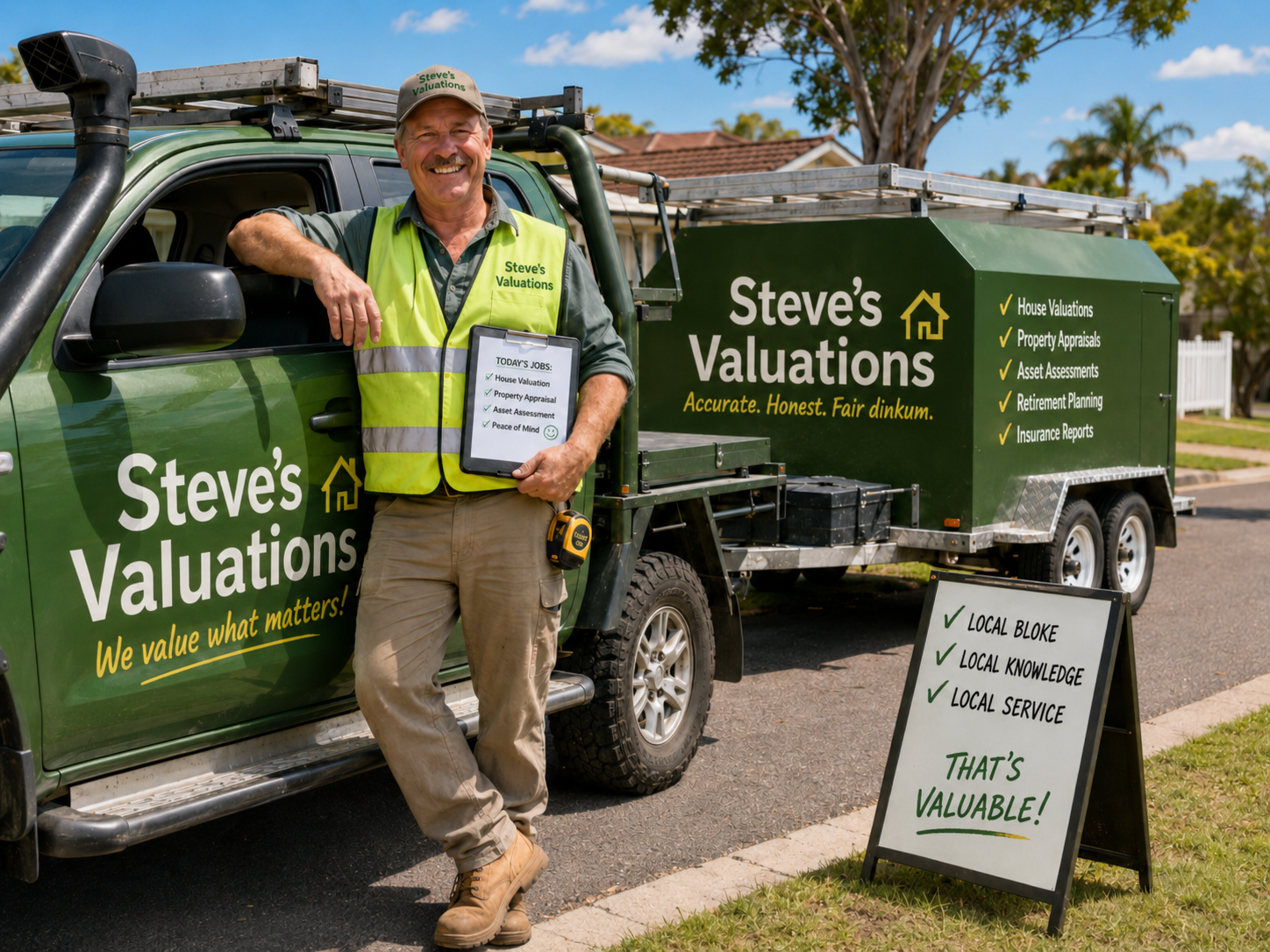

Local Bloke Steve to Become Registered Valuer
8 July 2026
ISSUE NO. 33
ADELAIDE — Local bloke Steve has confirmed he will become a registered asset valuer ahead of 1 July 2027, citing strong demand, attractive margins, no discernible barriers to entry, and a client base that only ever wants the number to go up.
From that date the 50% CGT discount is replaced by indexation and a 30% minimum tax. Assets held across the transition are split at their market value on 1 July 2027: the gain accrued to that date keeps the old treatment, the gain after it does not. Pre-CGT assets, exempt since 1985, are brought in at their 1 July 2027 value. Taxpayers may obtain a valuation or apply a formula. Treasury has not yet confirmed what a valuation is.
Steve intends to fill the gap.
Steve set out to register. He found nothing to register with. For most of what he proposed to value, no qualification, licence, or admitting body existed. Steve took this as encouragement. He now describes himself as registered, on the basis that he has registered the business name.
Steve previously installed ceiling insulation under the Home Insulation Program and later fitted rooftop solar under a separate rebate. He describes valuation as “the natural progression.” He owns a tape measure and a spreadsheet.
“There’s millions of assets and not enough blokes,” Steve said. “And I’m a bloke.”
Steve’s methodology is comparative. He identifies the most expensive thing he can see, and, comparatively, the asset in front of him is not dissimilar. His comparable set is cryptocurrency, non-fungible tokens, and Labubu figurines.
Because Steve indexes his valuations to the price of Bitcoin, a client’s 1 July 2027 value moves during the day. One client was quoted three times before lunch. Steve advised accepting the highest, on the ground that it was the most recent, and that value only travels in one direction.
A family farm held since 1979 was valued by reference to SpaceX, on the ground that both had a lot of space. A house was valued against the resale market for a JPEG of a monkey, on the ground that both had a lot of jumping around in them. A suburban dental practice was benchmarked against a Labubu figurine, on the ground that both had a lot of grinning teeth.
One client mentioned he held shares in a company that manufactures pumps. Steve established that the company had a website. A website is technology. Cryptocurrency is technology. Steve valued the pump company as cryptocurrency.
Where an asset had produced a loss, Steve multiplied the loss by a negative number, producing a gain. He cites the recent valuations of SpaceX and a large artificial intelligence company, each worth a fortune while losing money, as authority for the principle that a loss is a gain that has not yet been multiplied correctly.
Steve values every asset as it will stand on 1 July 2027, a date that has not yet occurred. Asked how he values a thing on a day that has not happened, Steve said the day was coming and the value was ready for it.
In each case the figure exceeded the client’s expectation. In each case the client did not dispute it. A higher value at 1 July 2027 shelters more of the gain under the outgoing discount and lifts the cost base that runs forward under indexation. Steve has not returned a valuation lower than the one requested.
A Treasury spokesperson said the framework gave taxpayers flexibility and choice.
A separate spokesperson said the valuation methodology would be confirmed in draft legislation.
A third spokesperson said there had always been valuers.
The model has been adopted quickly. Several accounting firms refer clients to Steve on the understanding that Steve is “client-aware” and “outcomes-oriented.” Steve has raised his fee twice and incorporated. A second bloke, Daryl, has entered the market. Daryl values everything against Steve.
The ATO has stated that valuations must be supported and objective. Steve says his are both. They are supported, because he supports them. They are objective, because they are objects.
Steve rejects any suggestion he is unqualified. He says he has always had a good feel for a bargain and a good sense of what a thing is worth. An asset is worth what someone says it is worth, and he is someone.
At press time, Steve had valued his own valuation business at $1.5 trillion. The company had recently added artificial intelligence, being another bloke’s ChatGPT login. Steve reached the figure by taking the net loss and multiplying it by a magic negative number.
This is a work of satire. No part of it constitutes valuation advice, although under the proposed rules it is unclear that anything does.