
Treasury to Use More than Wikipedia for Understanding Tax Law Before Next Budget
9th June 2026
ISSUE NO. 29
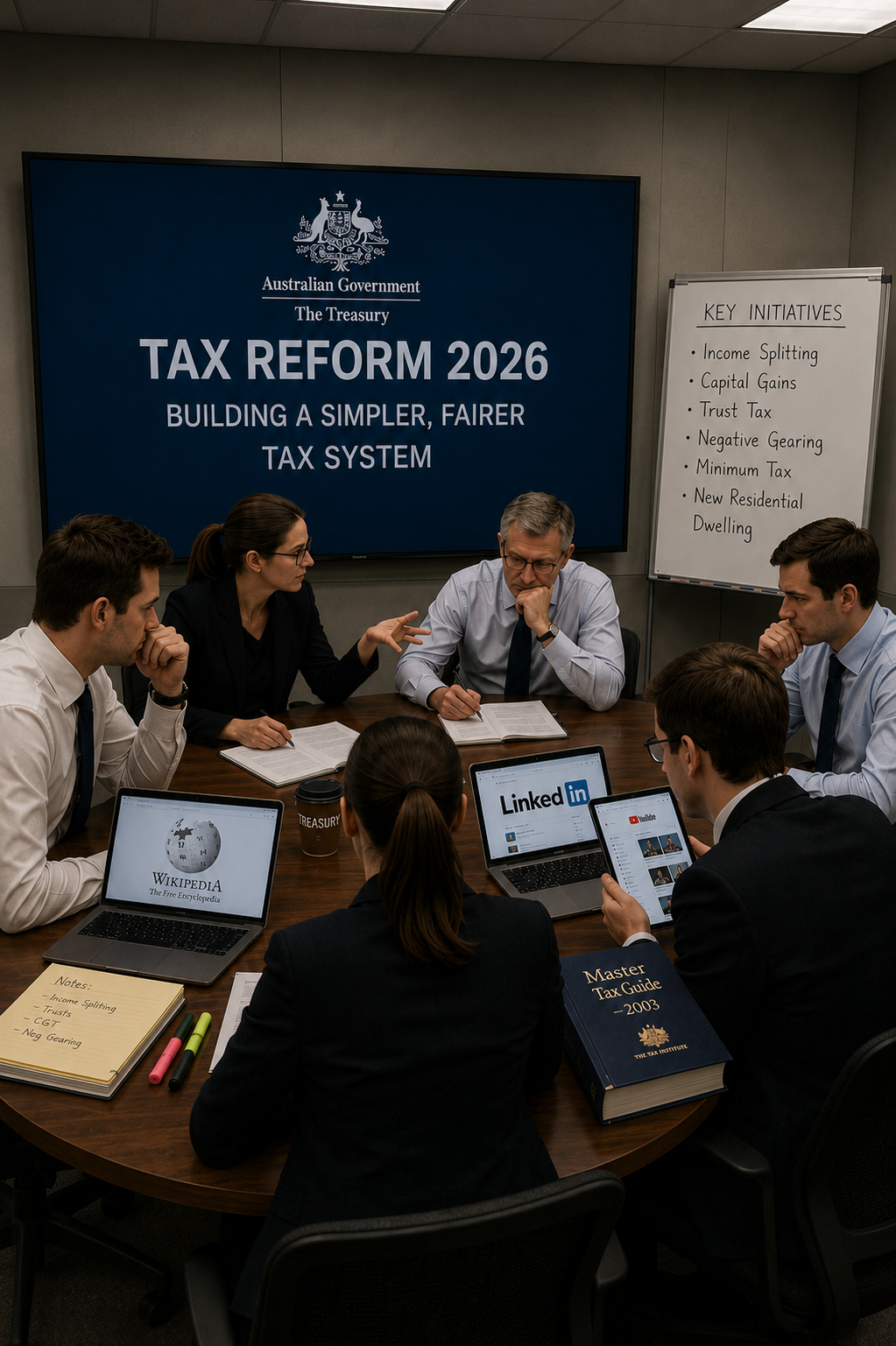
CANBERRA — The federal Treasury has confirmed it will consult a source other than Wikipedia when drafting the next round of tax legislation, following the release of a 2026-27 Budget package that practitioners say reads as though it were assembled from encyclopaedia summaries of tax concepts rather than the law itself.
A Treasury spokesperson said the department remained committed to a deeper evidence base, and confirmed that the income splitting section had been drafted with reference to the Wikipedia article “Income splitting,” which opens by comparing it to dividing a restaurant bill.
The commitment follows the introduction of the Treasury Laws Amendment (Tax Reform No. 1) Bill 2026, which replaces the 50 per cent CGT discount with cost-base indexation, splits a single capital gain into four categories, expands the net capital gain calculation to a seven-step method, and imposes a new 30 per cent minimum tax on the capital gains of resident individuals.
The Government has described the new system as simpler and more sustainable.
It arrives in seven steps and four flavours.
The four-category taxonomy was reportedly modelled on a 2003 edition of the Master Tax Guide, located in a Parliamentary Library storeroom, with the relevant pages annotated in pencil by a previous owner.
The flagship measure is a separate, announced 30 per cent minimum tax on discretionary trusts, justified on the basis that trusts are used for “income splitting.”
Tax practitioners noted that a discretionary trust does not split anyone’s income. The trustee derives the income. The beneficiary becomes presently entitled to a share of the income of the trust estate under section 97. There is no pre-existing lump belonging to one person that gets divided. “Income splitting” describes an outcome. It is not a mechanism.
Asked to explain present entitlement, Treasury referred this publication to the Wikipedia article “Trust (law),” and specifically to the third sentence, which it described as “comprehensive.”
The entire CGT discount retention, and the negative gearing carve-out, turn on whether a dwelling is a “new residential dwelling,” a term the Bill does not define. The definition will be set later by a ministerial legislative instrument that does not yet exist.
Treasury confirmed the definition was currently a red link.
“See main article: New Residential Dwelling,” a spokesperson said. “That page has not been created. There is a notice asking whether you would like to create it.”
The deemed-disposal apportionment method, the excluded entities for negative gearing, and the income-support exemptions from the minimum tax were also deferred to instruments not yet released, meaning Parliament will vote on the Bill before the operative pieces are written. The Government has defended legislating in tranches on the basis that it provides certainty to taxpayers.
The deferred pieces are the certainty.
Under the announced trustee minimum tax, the trustee pays 30 per cent, the beneficiary still returns the income, and a non-corporate beneficiary receives a non-refundable credit.
Practitioners asked whether a beneficiary entitled to a $100 distribution is presently entitled to $100, with a credit for the trustee’s $30, or to the $70 that can actually be distributed after the tax. The answer is a basic consequence of how present entitlement works. It is also absent.
Treasury was unable to locate the answer but noted that the concept of “after-tax income” was well explained in The Barefoot Investor, a copy of which was available in the staff kitchen.
It added that because the credit was non-refundable, a minor, a part-time student, or a tax-exempt beneficiary would bear the full 30 per cent with the credit wasted, which was the opposite of aligning trust income with the rates paid by workers and families. Treasury said this outcome was being looked into.
LinkedIn commentary on the package has been extensive. One chartered accountant posted a fourteen-part thread on the interaction between the new residential character deeming and the Bamford proportionate approach, observing that the deemed “residential” character keys to the beneficiary’s proportionate share of section 95 net income, that there is no mechanism to stream it the way franked distributions and capital gains can be streamed, and that the character can therefore detach entirely from the beneficiary who economically bears the loss.
The post received 847 reactions and 214 comments, all of which were also concerns. Several concluded with the word “thoughts?”
Treasury confirmed it had not read the thread but had read the heading.
Treasury said the research upgrade would not affect the drafting timeline for Tax Reform No. 2, and that the department was considering acquiring a textbook.
Asked which textbook, the spokesperson said that detail was still under consideration, and that in the interim the relevant officer had bookmarked a YouTube video titled “AUSTRALIAN TAX EXPLAINED (in 10 minutes).”
The video is eight minutes long.
This article is satire. The definition of satire will be set by a legislative instrument that has not yet been released.